|
|
|
Now that we're approaching November it'll be no surprise to you that I've chosen the poppy as this month's flower. The poppy is of course synonymous with death and remembrance, and before that, opium, but that's been done to death! (If you'll pardon the pun!) I'm going to delve into the ancient myths and medicinal uses that are perhaps not as well known or recognised as our beloved remembrance symbol. There's a lot more to the common poppy than meets the eye! There are about 50 other species of Poppy that are grown for their attractive flowers and interestingly cut foliage.
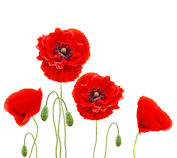 Papaver rhoeas
Corn Poppy
Poppy, or Papaver to give it its posh Latin name, is a species of flowering plant in the family Papaveraceae. Good to know! Like all other common flowers, poppy has its fair share of colloquial names, although not very imaginative, I have to say: Common Poppy, Corn Poppy, Field Poppy, Flanders Poppy, Red Poppy and, you guessed it, Shirley Poppy. Slightly more adventurous is Corn Rose, Red Weed and Coquelicot.
Coquelicot is the French name for poppy. The name was given to the plant in the 16th century due to its resemblance to a rooster's red comb, coq in French meaning rooster. (Can't see it myself...). The word coquelicot is sometimes used in English to describe its distinctive red colour.
|
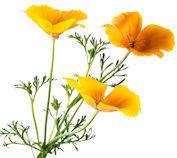 Eschscholzia californica
California Poppy
 Meconopsis cambrica
Welsh Poppy
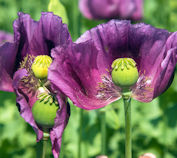 Papavar somniferum
Opium Poppy
 Papaver orientale
Oriental Poppy
|
You may recognise Eschscholzia californica as the California Poppy, the state flower of California, an annual, native to the Pacific slope of North America. Eschscholzia rhombipetala, the diamond-petaled California poppy, is rare and was thought to be extinct until it was rediscovered in 1992 in the Carrizo Plain in San Luis Obispo County, California. It is a relative of the California poppy, with diminutive flowers.
Welsh Poppies or Meconopsis cambrica. These little annuals pop up without fail every year in the gardens of the Hampstead Garden Suburb and beyond.
Papaver rhoeas or the Corn Poppy is the symbol of Remembrance Day, but the origin of the corn poppy's association with corn fields and the dead dates back much further than the early 20th century, right back to Osiris, Egyptian god of the dead. As Osiris was also the god of agriculture, the cutting of the corn during harvest came to represent his death, the red poppy growing in cornfields resembling splashes of blood. Poppy came to symbolise rebirth and regeneration, as poppy seeds would combine with the corn seed, to reappear with the crop the following year.
Papaver orientale or the Oriental Poppy, is a perennial ornamental poppy native to the Caucasus, northeastern Turkey and northern Iran.
Papavar somniferum is commonly known as the Opium Poppy, or breadseed poppy, as this species is the only one whose seeds can be used in baking. One country that has played a big part in the history of opium is China. First introduced between the 4th and 12th Centuries AD via the Silk Road trading route, by the 1600s, opium was smoked with tobacco by the social elite. This recreational use of opium soon spread to the lower classes and its popularity soared. British traders from the East India Company sold large quantities of opium to smugglers to meet the growing demand for the drug.
The Chinese Emperor began to take serious measures to stop the illegal importation of opium, and in 1838 opium worth millions was destroyed by the Chinese Commissioner Lin Zexu. Since opium smuggling accounted for 15-20% of income for the British Empire, they started the First Opium War on 18th March 1839 to combat the clampdown. The British won in 1842, leading to the Treaty of Nanking. This treaty gave Hong Kong Island to Britain, allowed for free British trade with any merchants in China, and forced China to pay a total of 21 million ounces of silver in compensation for the destroyed opium.
Poppies of old
Poppies have been grown since before records began. Some of the earliest records of poppies grown as ornamental plants date back to 5000 BC in Mesopotamia. They were found in Egyptian tombs.
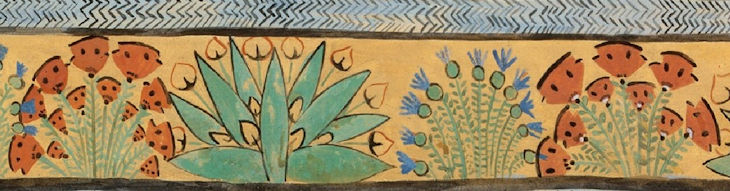 Poppies with mandrakes and cornflowers at the tomb of Sennedjem at Deir el-Medina
|
|
Poppies were conspicuous in elaborate jewellery as well as pieces of furniture such as the chest from the tomb of Tutankhamun.
In Greek and Roman myths, poppies were used as offerings to the dead. Poppies were used as emblems on tombstones to symbolize eternal sleep.
In Greek mythology, the poppy was associated with Demeter, goddess of fertility and agriculture. The gods gave Demeter a poppy to help her sleep after her daughter Persephone was abducted. Afterwards, poppies sprang from Demeter's footsteps. She also transformed her mortal lover, Mecon, into a poppy.
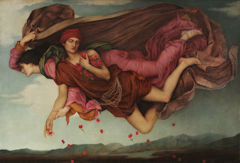 Night and Sleep (1878)
Evelyn De Morgan
In Evelyn De Morgan's painting "Night and Sleep" dark-haired Nix guides her sleepy son Morpheus through the twilight skies, as he listlessly sprinkles poppies over the sleeping mortals below, to ensure a good night's sleep was had by all.
The drug morphine, which is derived from poppies, gets its name from the God of Dreams, Morpheus. While visiting countless bedrooms, shaping dreams of mere mortals as he wished, Morpheus slept in a cave full of poppy seeds. Legend has it that Morpheus used his wings not only to reach those who needed help in their dreams but also to carry his father, the wingless Hypnos, who by all accounts was a pretty lazy deity, spending most of his time sleeping. His mother Nyx was the goddess of Night, and his uncle, the fearsome Thanatos, bringer of death. The entire family is depicted with crowns of poppies. Bet they were a blast at family gatherings!
In Australia and New Zealand, 'tall poppy syndrome' is a term that refers to successful people being criticised. This occurs when their peers believe they are too successful or are bragging about their success. Intense scrutiny and criticism of such a person is termed as 'Cutting down the tall poppy'. It has been described as being the by-product of the Australian and New Zealand cultural value of egalitarianism.
 Tarquinius Superbus (1867)
Sir Lawrence Alma-Tadema
Tall Poppy Syndrome gets its name from a story told about King Tarquin the Proud, the last Roman king who ruled from about 534 BC to 509 BC, by the historian Livy. Tarquin's son Sextus was infiltrating the leadership in a neighbouring city and asked his father what he should do next. Tarquin did not say anything but went into his garden and cut the heads off all the tallest poppies with his sword. Sextus took that to mean he should destroy the leading aristocrats of the city, which he did. Rome then easily overtook the city.
As a side note, Sextus was the person who infamously raped Lucretia. After the assault, Lucretia's sense of honour and shame led her to reveal the crime to her husband and father, and she made them promise to avenge her and she tragically killed herself out of shame. This stirred sufficient outrage and sparked the popular revolt against the oppressive rule of the Tarquin kings. The revolt led to the expulsion of Tarquin the Proud from Rome in 509 BC. This event marked the end of the Roman monarchy and the establishment of the Roman Republic.
The Tall Poppy story, however, is perhaps even older. Herodotus describes Thrasybulus, the tyrant of Miletus (7th century BC), doing the same thing in a grain field as advice to Periander, who had just seized power in Corinth.
Medicinal Uses.
The Sumerians, who called poppies the joy plant, grew it by 3400 BC, probably infusing the capsules, in water, mead, or wine to produce the analgesic tea the ancient Greeks called mekonion. A piece of evidence for the use of opium by the Sumerians is a tablet of medical prescriptions found at Nippur, (2100 BC) containing a cuneiform ideogram "hul-gil", translated as "joy plant".
In ancient Egypt, the opium poppy is mentioned in the Papyrus Ebers (1550 BC) to provide anaesthetic remedies for several ailments, such relieving insomnia, relieving headaches, soothing respiratory problems and deadening pain. It was also an ingredient together with "Fly dirt which is on the Wall" in a potion for quieting a crying child. (Don't try this at home, folks!)
The earliest written Greek record of poppies appeared in the 8th century BC. Early Greek accounts seem to indicate the plant was used for euthanasia; on some Greek islands, women used it in old age to shorten the time left until natural death.
Pliny the Elder, (23/24 AD-79 AD) a Roman historian, wrote about medical applications of the plant; the leaves and capsules were boiled in water to create juice, pressed and rubbed to create tablets, and the dried latex was used to form opium. These products were used in much the same way they are in many cultures today, to promote sleep and to relieve indigestion and respiratory problems.
A century later, around 200 AD, Galen, a Greek physician, surgeon and philosopher, wrote even more extensively about the diverse applications of various poppy products. He wrote that opium was the strongest known drug for dulling the senses and for inducing sleep. He wrote about its use to treat a variety of ailments, including eye and lung inflammation.
In 1803, morphine, the principal ingredient in opium, was extracted from opium resin by Friedrich Wilhelm Adam Sertürner. He became the co-founder and promoter of a new type of chemistry now known as alkaloid chemistry. Hailed as a miracle drug, morphine was widely prescribed by physicians in the mid-1800s.
 The Coat of Arms of The
Royal College of Anaesthetists.
In 1874, C. R. Wright at St. Mary's Hospital in London isolated "Heroin" (diacetylmorphine) as a by-product of his work to determine the constitution of some natural and purified alkaloids. In the last decade of the 19th century Dreser and other investigators studied the physiological effects of diacetylmorphine. The favourable reports of these investigators along with the growing interest in the drug shown by the medical profession of that time, led the Bayer Company in Eberfeld, Germany, to start production of the compound on a commercial scale (1898). The new compound was marketed by Bayer under the name "Heroin".
Today, morphine and codeine are common alkaloids found in several poppy varieties and are important drugs for much of the world, heroin not so much.
Given their association with sleep, it's no surprise that opium poppies appear on the coat of arms of the Royal College of Anaesthetists.
Poppies in Popular Culture.
As well as the California Poppy being the state flower of California, The Red Poppy (Papaver rhoeas) is the national flower of Albania, Belgium and Poland. However, the Opium Poppy (Papavar somniferum) is the national flower of Macedonia. Poppies also regularly feature on postage stamps.
|
 Albanian stamp (2008)
 Belgian stamp (1949)
 Polish stamp (1967)
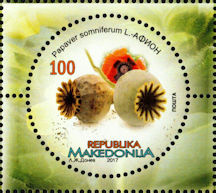 Macedonian stamp (2017)
|
In Mexico, Grupo Modelo, the makers of Corona beer, used red poppies in most of its advertising images until the 1960s including bar accessories such as this 1960's Corona Cervaza Extra Beer Victoria Girl Red Metal Beverage Tray.
Poppy fragrances are also found in perfumes and colognes with over 100 different varieties available in the current marketplace containing a poppy fragrance. The poster is for a 1950's Ukrainian LVOV Poppy Cologne from the Russian National Library, St. Petersburg.
|
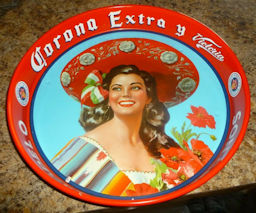 Corona Beer Beverage Tray
 Poppy Cologne Poster
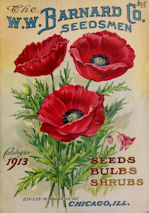 Advert for seeds, flowers
& bulbs catalogue (1913)
 Victorian Christmas Card
|
The history of the Remembrance Poppy
Struck by the sight of bright red blooms on broken ground, Lieutenant Colonel John McCrae, a Canadian who served as a brigade surgeon for an Allied artillery unit, wrote a poem, "In Flanders Field", in which he channelled the voice of the fallen soldiers buried under those hardy poppies. It was first published in Punch magazine in late 1915.
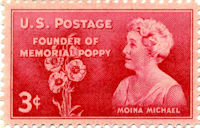 Moina Michael memorial stamp
issued 9 Nov 1948
In November 1918, Moina Michael read "In Flanders Field" in the pages of Ladies' Home Journal and she wrote her own poem in response, which she called "We Shall Keep Faith". After the war ended, she returned to the university town of Athens, Georgia and came up with the idea of making and selling red silk poppies to raise money to support returning veterans. In mid-1920, she managed to get Georgia's branch of the American Legion, a veteran's group, to adopt the poppy as its symbol followed by the National American Legion voting to use the poppy as the official U.S. national emblem of remembrance in September 1920 at its Cleveland convention.
A Frenchwoman named Anna Guérin, who had championed the symbolic power of the red poppy from the beginning, spoke about her idea for an "Inter-Allied Poppy Day" at the Cleveland convention. Back in France, Guérin organized French women, children and veterans to make and sell artificial poppies as a way to fund the restoration of war-torn France. Within a year, Guérin brought her campaign to England, where in November 1921 the newly founded (Royal) British Legion held its first-ever "Poppy Appeal", which sold millions of silk flowers and raised over £106,000 (a hefty sum at the time) to go towards finding employment and housing for Great War veterans.
In New Zealand poppies are worn in the two weeks before ANZAC Day (25th April), while in the USA poppies tend to be worn in the run up to Memorial Day (the last Monday in May). In the UK, Canada and Australia Remembrance Poppies are worn from the last Friday in October to Remembrance Day
Poppies in Literature.
'Through the dancing poppies stole a breeze most softly lulling to my soul. John Keats
Shakespeare mentions poppies only once in his works, in Othello, but alludes to opium in Romeo and Juliet. During Shakespeare's time, opium was a staple in any doctor's practice. Doctors used the drug to treat a range of ailments, including insomnia, diarrhoea, cholera and period pains. The herbalist John Gerard describes the many benefits of the flower, such as the plant's ability to "provoke sleep."
|
|
'Not poppy, nor mandragora,
Nor all the drowsy syrups of the world,
Shall ever medicine thee to that sweet sleep
Which thou owedst yesterday.'
Othello, Act 3, Scene 3.
|
'Within the infant rind of this weak flower
Poison hath residence, and medicine power,
For this, being smelt, with that part cheers each part;
Being tasted, slays all senses with the heart.'
Romeo and Juliet, Act 2, Scene 2
|
|
|
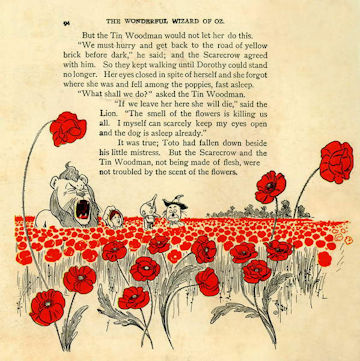
In L. Frank Baum's 1900 children's novel The Wonderful Wizard of Oz, a magical poppy field threatened to make the protagonists sleep forever.
|
|
|
Poppies in Art.
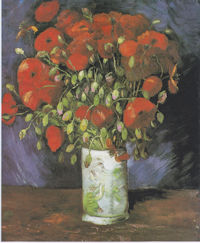 Vase of Poppies (1886)
Vincent van Gogh
Vase of Poppies, a still life oil painting at the Wadsworth Atheneum Museum of Art in Hartford, that had been languishing in storage for over thirty years, was verified by researchers at the Van Gogh Museum in Amsterdam as having been painted by the Dutch artist in 1886, just after he moved to Paris.
The painting's authenticity was called into question in 1990 by the art historian Walter Feilchenfeldt, (what did he know!) but in 2019, with advances in technology and better knowledge of van Gogh, the museum decided to revisit the painting. It was examined initially at the Atheneum, where a digital X-ray revealed an underpainting that looked like a self-portrait, which added to confidence about its authenticity. The museum in Amsterdam then analysed the artwork's paint, materials and style to conclude it was indeed done by van Gogh.
Van Gogh seems to have loved poppies since his youth, presumably because of their striking red colour. While in London, at the age of 21, he wrote about life with the Loyers, the mother and daughter with whom he was lodging. In late April 1874 he said he was doing a lot of gardening and had "sown sweet peas, poppies and reseda, now we just have to wait and see what comes of it".
Pre-Raphaelite movement
The Pre-Raphaelites were a group of English painters, poets, and art critics, founded in 1848. It was greatly influenced by nature and its members used great detail to show the natural world using bright and sharp-focus techniques on a white canvas. The image of poppies is a favourite of the Pre-Raphaelite movement, no doubt due to its morbid connection to death!
|
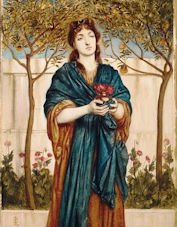 Priestess Offering Poppies
Simeon Solomon (1864)
 Beata Beatrix
Dante Gabriel Rossetti (1870)
 Death the Bride
Thomas Cooper Gotch (1894/5)
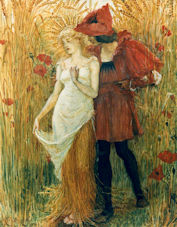 Poppy Time
Walter Crane (1893)
|
In Simeon Solomon 1864 painting the priestess offering up a poppy, is a symbol of remembrance but also serves as a metaphor for fleeting beauty and mortality.
Beata Beatrix is a painting completed in several versions by Dante Gabriel Rossetti. The painting depicts Beatrice Portinari from Dante Alighieri's 1294 poem La Vita Nuova at the moment of her death. The picture is a portrait of Elizabeth Siddall in the character of Italian poet Dante's Beatrice. Beatrice's impending death is evoked by the red dove, a messenger of love, which descends towards her, an opium poppy in its beak.
Artist Thomas Cooper Gotch depicts a black-veiled young woman, a 'bride', walking through a field of poppies, creating an association, of the flower and the young woman, with allure and death.
Walter Crane was influenced by Burne-Jones and the Pre-Raphaelites and was also associated with William Morris and the Arts and Crafts Movement. Poppies were a favourite theme in Crane's work. Besides painting, he also illustrated books, designed ceramic tiles and wallpapers and was involved in other decorative arts.
Arts & Crafts, Art Nouveau and Art Deco Movements
There are so many depictions of poppies, from the early 20th century Arts & Crafts movement, especially by William Morris, to Art Nouveau and later Art Deco, that I've just picked out some of my favourites.
|
 Art Nouveau Poppy Vase
WMF Germany (1905)
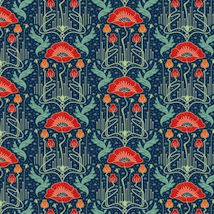 Art Nouveau Red Poppy Design
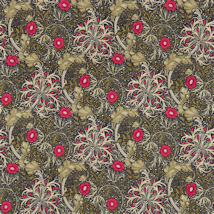 Seaweed Ebony-Poppy Design
William Morris
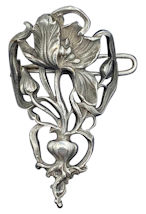 French Poppy Flower
Scarf Brooch (1900)
|
During my research I discovered May Morris, younger daughter of William Morris, who was a significant figure in the British Arts and Crafts movement and a pioneer of 'art embroidery'. (Incidentally, her mother Jane was the renowned Pre-Raphaelite model.) May ran the embroidery department of Morris & Co., as well as designing textiles, wallpapers and jewellery. May was also an influential teacher and lectured in the UK and America.
Truly an unsung hero, during her time in the role she was responsible for producing a range of designs, which were frequently misattributed as her father's work. So, let's hear it for May Morris!
|
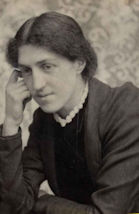 May Morris
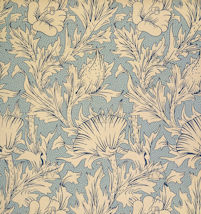 Horn Poppy Design
May Morris (1885)
 White poppy & green reeds
decorative border pattern
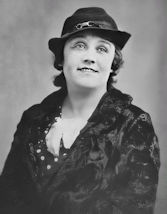 Clarice Cliff
|
The colourful, bold designs of Clarice Cliff's pottery scream Art Deco! Clarice was born in 1899 to a working-class family in Stoke-on-Trent. She started work at the A J Wilkinson pottery factory at 13, but by 1927 was given her own studio, where she launched her revolutionary Bizarre wares. By 1929, Cliff's decorators had grown to a team of around 70 young painters. Of those, 66 were women (called 'Bizarre girls') and 4 were boys. At a time when there was no such thing as Career Women, Clarice Cliff's fame and success, as Company Art Director, in the 1930s are hard to fully appreciate now, but at that time there was no such thing as 'career women'. Today, the instantly recognisable Clarice Cliff art pottery is highly collected worldwide and it is widely accepted that she brought modern art to the people.
|
 Delecia Poppy 451 Vase
Clarice Cliff (C.1932)
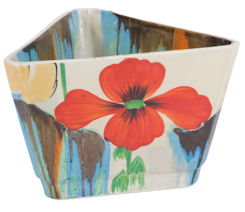 Three Sided Planter
Clarice Cliff
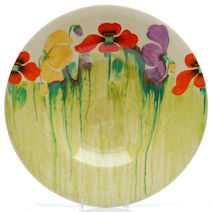 13" Ribbed Charger
Clarice Cliff (C.1935)
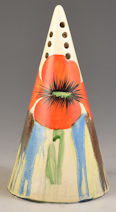 Conical Sugar Sifter
Clarice Cliff (C.1934)
|
Moorcroft Pottery and Liberty
One of the things I love about researching these flowers is the unexpected roads my Googlings take me! Having spent the best part of 8 years selling Moorcroft pottery at Liberty I was bound to include some of the iconic pieces here.
William Moorcroft was a graduate of what is now the Royal College of Art in London, and started creating his art pottery in 1897 whilst employed at James Macintiye and Co. In 1913, with the aid of substantial funds from Liberty, William was able to move production of his art pottery to the present factory in Sandbach Road under the name of W. Moorcroft Ltd. The quality of Moorcroft design and the artistic skills of its workforce means that more than 100 years later, the company is still supplying Liberty. Moorcroft favours poppies so much they have been incorporated in designs from the get-go right up to the present day!
|
 Big Poppy
William Moorcroft (1920)
Moorcroft Pottery
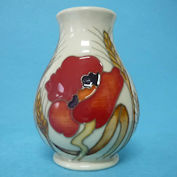 Harvest Poppy
Emma Bossons (2016)
Moorcroft Pottery
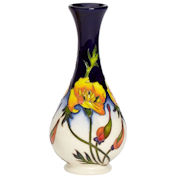 California Poppy
Nicola Slaney (2021)
Moorcroft Pottery
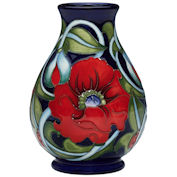 Ode to a Poppy
Rachel Bishop (2022)
Moorcroft Pottery
|
Poppy Jewellery
Poppies have long been associated with death, repose, and eternal sleep. Poppy flowers also symbolize beauty, magic, consolation, humility, fertility, prosperity, and eternal life.. It has been used as a symbol in various cultures and has found its way into jewellery designs. The North London Gardeners Store has the following items:
|
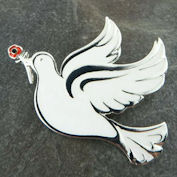 Dove Brooch with Poppy
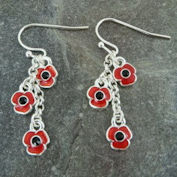 Red Poppy Drop Hook Earring
 Red Poppy Stud Earring
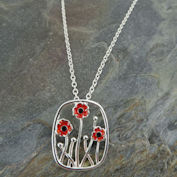 Three Small Red Poppies
Pendant with Chain
|
 Poppy Cufflink
 Red Poppy On Stem Brooch
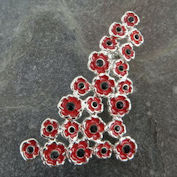 Falling Poppy Brooch
 Red Poppy Heart
Pendant with Chain
|
How to take care of Poppies
How to sow poppy seeds
- Choose a sunny spot with good drainage. Weed the area and rake to a fine tilth.
- Pour some poppy seeds into your hand and sprinkle them very thinly across the ground to create natural looking drifts.
- Allow 7-30 days to germinate, depending on the variety, soil condition and growing temperatures. Keep the soil moist during germination.
- Once the seedlings are large enough to handle, thin them out to around 30cm (12in) apart.
- Water the area regularly, especially during dry spells. Be careful not to overdo it as this encourages quick growth and leggy plants, or even rot.
Top tips for growing poppies
- Water poppies during dry spells, but don't oversaturate.
- Deadhead faded poppy flowers often to encourage more blooms.
- If left to seed poppies self-sow, so avoid unwanted spread by removing faded flowers in good time.
- To harvest seed pods, cut when the pods turn light brown and dry out for 1-2 weeks before breaking open and storing seeds in a jar for up to two years.
- Once annual poppies have gone to seed, pull up parent plants and compost.
- For biennials and perennials, cut back old foliage to ground level in autumn.
- Divide clumps of poppies in late summer when they've finished blooming. Take care, as early separation can damage sensitive taproots.
Pests & diseases
Most of the annual poppies are pretty trouble free, but there are some pests and diseases that can attack, particularly the perennial oriental poppies.
- Aphids can appear on the tips in spring, so squash any that you see, and wait for the ladybirds and lace wings to come to your rescue. They can cause quite severe disfiguration of the leaves so SB plant invigorator is a good treatment if the problem persists.
- Downy mildew is a fungal disease that attacks mainly young plants, leaving yellow patches on the upper surface of the leaves. Remove affected leaves as soon as you see the problem and ensure good air circulation. Make sure that your poppy plants are not growing too close together in the row and try not to water from above.
- Powdery mildew is a fungal disease that can affect the leaves, but plants usually recover without treatment. Remove affected leaves promptly. It is caused by dryness at the roots and dampness around the leaves, so ensure you water at the base.
- Pedicel necrosis is a disease that affects the flower buds which turn brown and fail to open properly. It is usually caused by too much rapid growth promoted by high nitrogen fertiliser. So, make sure you do not overfeed your plants.
|


 P.O.Box 176, Wood Green, London UK N22 4BT
 +44 (0)20 8211 3325
 webmaster@teg.co.uk
Site Map
Legal Info
webmaster@teg.co.uk
Site Map
Legal Info