|
Our native Foxglove, or to give it is proper name digitalis purpurea, is a biennial plant native to Europe, North Africa and Central Asia. In 1753, Swedish botanist Carl Linnaeus, who formalised binomial nomenclature, the modern system of naming organisms, and known as the 'father of modern taxonomy', gave foxglove its Latin name simply because he thought the flowers looked like the fingertips of gloves.
The name foxglove exists in a list of plants as far back as the 14th century. The prefix fox has most likely been derived from folks, who to our ancestors of that time were the fairies, but to speak of them explicitly was believed to get their attention & cause them to do mischief. Glove may have come from the Anglo-Saxon gliew, which was the name for a musical instrument consisting of many small bells, put the two together to make Fairy Bells.
Some stories have told that the word foxglove is merely a misrepresentation of "folk's glove", gloves little people might wear. Others say fairies gave the flowers to the foxes to put on their paws to enable them to sneak silently into the hen house without being heard. This story is echoed in the belief that the mottled spots inside the flowers are actually fairy handprints.
|
|
In the earliest recordings of the Language of Flowers, foxgloves symbolized riddles, conundrums, and secrets, but by the Victorian era they had devolved into the more negative symbol of insincerity.
In Welsh, Maneg Ellyllyn translates as The Good People's Glove. In Gaelic they were Lus Mor, the Great Herb, for being the most magical of all herbs.
A whole host of alternative common names reflect the association with fairies: Fairy Caps, Fairy Gloves, Fairy Thimbles, Fairy Herb, Fairybells, Fairy-fingers, Goblin Gloves, Fairy Petticoats, Fairyweed. The names Flopdock, Floppydock, Flop-a-Dock, Flapdock, Popdock, Flop-poppy, Flop-top, Cowflop, Gooseflops, Rabbit's Flowers or Bunny Rabbits all allude to the foxglove's large soft downy leaves.
|
|
Superstitions surrounding the foxglove were rife. If white flowers occur in a garden there will be a death in the family. Foxglove leaves placed in a child's shoes and worn thus for a year were supposed to cure scarlet fever. Planting foxgloves in your garden may grant you protection but picking foxgloves was considered unlucky and they were forbidden inside the house as this gave witches and the devil access to the house. And due no doubt to its toxicity it was also referred to as Dead Man's Bells because if you hear the bells ring you will die soon.
A 19th century name for foxglove was snowper (rhymes with cow). A favourite admonition to a noisy child was, "Shut thee chops; thee bist like a bumble bee in a snowper!". A favourite occupation in summer was to trap a bee in a foxglove flower to hear it buzzing noisily.
Legend has it that fairies would hide themselves inside the flowers. Mischievous children, wanting to hear fairy thunder, would hold one of the flower bells, then strike the other end on their hand. The poor fairy, rightly upset and probably rather cross, would make a snapping sound, a clap of fairy thunder, while she escaped from her retreat.
In Roman times, foxglove was a flower sacred to the goddess Flora, who touched Hera on her breasts and belly with foxglove in order to impregnate her with the god Mars. As a result, the plant has been associated with midwifery and women's magic ever since, giving rise to the names Granny's Gloves or Granny's Bonnets, & Witch's or Witches' Gloves.
White witches (practitioners of benign and healing magic) are said to live in the wild with vixen familiars, the latter marked by bells made of foxglove blossoms tied around their necks.
In medieval gardens, the plant was believed to be sacred to the Virgin Mary.
Medicinal Practices
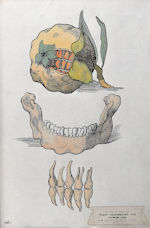 A pomegranate resembling
the human jaw
The doctrine of signatures, dating back to the late 15th century, states that herbs resembling various parts of the body can be used by herbalists to treat ailments of those body parts. A theological justification, as stated by botanists, was that God would have wanted to show men what plants would be useful for. 17th century botanist William Coles wrote, "Herbes for the use of men, and hath given them particular Signatures, whereby a man may read the use of them".
Foxglove flowers were supposed to look like an animal's open mouth. Within the doctrine of signatures this meant it must have some medicinal value in the treatment of injuries of the mouth & throat. The speckles in the mouth of the flower were, according to the Doctrine, symbolic of inflammation of the throat. An array of folk-names reflects the foxglove's association with the mouth: Throatwort, Rabbit's Mouth, Bunny Mouths, Tiger's Mouth, Duck's Mouth, Gap-Mouth, & Dragon's Mouth.
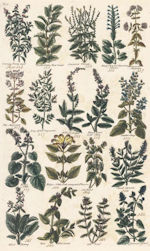 Plate from
The Complete Herbal
In his The Complete Herbal, Nicholas Culpepper, a 17th century English botanist, herbalist, physician and astrologer, recommends the plant be used to treat the "King's Evil" (scrofula), or to clean sores. Another, less charming name of Scabbit Dock came about as, in Culpepper's day, foxglove was used in an ointment or shampoo for treating impetigo or 'scabby head'.
A 13th century Welsh legend mentioned in Terri Windling's "Myth and Moor: The folklore of foxgloves", Terry Breverton's "The Physicians of Myddfai" and Harold Selcon's "Physicians of Myddfai: Myth Magic Medicine and Mayhem in Medieval Wales" tells of an historical figure Rhiwallon, the physician to Prince Rhys the Hoarse, of South Wales. Young Rhiwallon was walking beside a lake one evening when from the mist rose a golden boat. A beautiful maiden was rowing the boat with golden oars. She glided softly away in the mist before he could speak to her. Rhiwallon returned every evening looking for the maiden; when he did not find her, he asked advice from a wise man. He told Rhiwallon to offer her cheese. Rhiwallon did as he was told, the maiden appeared and took his offering. She came ashore, became his wife, and bore him three sons.
After the sons grew and the youngest became a man, Rhiwallon's wife rowed into the lake one day and returned with a magic box hinged with jewels. She told Rhiwallon he must strike her three times so that she could return to the mist forever. He refused to hit her, but the next morning as he finished breakfast and prepared to go to work, Rhiwallon tapped his wife affectionately on the shoulder three times. Instantly a cloud of mist enveloped her and she disappeared. Left behind was the bejewelled magic box. When the three sons opened it, they found a list of all the medicinal herbs, including foxglove, with full directions for their use and healing properties. With this knowledge the sons are said to have become the most famous of physicians.
Although the first recorded use of foxglove as a medicinal herb dates back to the 16th century when it was used as a diuretic to treat dropsy, or edema as it is known today, a condition that causes fluid to build up in the body, it wasn't until the 18th century that William Withering, an English physician, discovered the plant's powerful effects on the heart. He used it to treat patients with congestive heart failure, and his findings were published in his book "An Account of the Foxglove and Some of its Medicinal Uses" in 1785. Withering's insights on the medical uses of foxglove proved crucial to the modern understanding of heart failure, and today drugs containing digitalis are still prescribed. It is thought that Dr Withering learned of its potency from an unnamed midwife.
Used wrongly it is highly toxic, causing heart palpitations, delirium, hallucinations, vomiting, & possibly death. For this reason, modern herbalists have stopped using it.
Foxglove in Art
Considering how widespread and synonymous with English woodland the foxglove is, there is surprisingly little in the way of pre-20th century art depicting the image of the foxglove. The pre-Raphaelites certainly didn't like it as I couldn't find any evidence of it in their paintings. Maybe superstition, particularly rife in Victorian times, and its poisonous reputation, put artists off, but that is mere speculation on my part.
I have found some images that I've included purely because I like them, and this one in particular has tickled my fancy!
|
How to take care of Foxgloves
Iconic and romantic, our native foxglove, or digitalis to give it its proper name, so synonymous with English cottage gardens, is actually native to Europe, western Asia, and northwestern Africa. Digitalis is a genus of about 20 species of herbaceous perennials including D ferruginea, D grandiflora, D lutea, and D parviflora. Foxgloves can be biennials or short-lived perennials and are grown for their tall spires of tubular flowers. They bloom for several months, usually from late spring or early summer. Our two native foxgloves, Digitalis purpurea and D. purpurea f. albiflora, produce flowers of pinky-purple or white respectively. There are many other species and cultivars to choose from, in a range of pastel or bold colours.
Foxgloves are woodland plants, so prefer dappled to deep shade, in soil that is rich in organic matter. It is worth noting that all foxgloves are highly toxic, so you should always wear gloves when handling plants and seeds.
Sow seeds in late summer, ready for planting in early autumn so that they can establish the root system before cold weather arrives. Scatter the tiny seeds thinly into a tray of moist seed or cuttings compost. Press the seeds gently down to make good contact with the surface. Foxglove seeds need light to germinate, so don't be tempted to cover them with compost.
Perennial foxgloves, such as the rusty foxglove (Digitalis ferruginea), can also be grown from off-shoots around the base in spring. The resulting plants will be genetic copies of the parent plant. It can grow in sunnier sites, but it needs rich, moisture-retentive soil.
When planting out the seedlings take care to space young plants 30-35cm (12-14in) apart. If they don't have plenty of room to spread out their rosette of leaves, they will often wait as small rosettes until their neighbours have flowered and died, making way for them to flower the following (third) year.
Water newly planted foxgloves regularly for at least the first few months, to help them until their roots have spread out into the soil. Once established, foxgloves growing in soil that is rich in organic matter should only need watering in long dry spells in summer. Wilting large leaves are a good indicator that plants need a good long soak. Foxgloves growing in containers need regular watering throughout the growing season, as the compost will dry out quickly, especially in summer. Aim to keep the compost slightly moist but never waterlogged
Cut the centre flower stalk back after flowering to encourage additional flower stalks to develop later in the season. Leave the flower stalk on the plant if you want it to reseed, as well as to attract birds to the garden in the Autumn.
Foxgloves are generally low maintenance and suffer few problems. Still, it is worth looking out for the following:
- Aphids can colonise developing flowers spikes - they can usually be washed off with a hose, but be careful not to damage the stem.
- Slugs and snails are fond of foxglove seedlings, so put protection in place if possible, or keep in pots until plants are more robust. As seedlings grow, their leaves get hairier and less attractive to slugs.
- Leaf and bud eelworms can damage the leaves, but can easily be confused with weather damage or fungal leaf spots.
- Powdery mildew is a fungal disease that can affect the leaves, but plants usually recover without treatment.
- Mutated flowers - foxgloves very occasionally display a fascinating and spectacular floral mutation called terminal peloria, where the top flower opens out fully, looking like a pretty satellite dish. It is either caused by genetic disruption in the young plant, from erratic weather or physical damage, or inherited from affected parent plants.
|


 P.O.Box 176, Wood Green, London UK N22 4BT
 +44 (0)20 8211 3325
 webmaster@teg.co.uk
Site Map
Legal Info
webmaster@teg.co.uk
Site Map
Legal Info