This summer's unprecedented heatwave has been a steep learning curve for me, as I'm sure it has been for all gardeners who thought they knew their onions. Over the years I have adhered to the Right Plant Right Place principle, selecting perennials that would thrive in both the dry shade under the apple tree, to the full uninterrupted sunny border, and part shade in between. Pulmonarias and brunneras thrived in the shade, providing lovely blue flowers in the spring and a tapestry of foliage well into autumn. Rudbeckias, phlox and crocosmias pumped out bold colours in late summer. I pride myself on my careful choices to promote the survival of the fittest, I mulch the beds every spring religiously. In addition to our irrigation system, I water either early morning or in the evening, aiming the flow at the roots so as not to waste water, I apply the appropriate fertiliser, I deadhead regularly. What more can a keen gardener do to nurture her plot?
Persicaria, so adaptable and practically bomb proof, drought or sodden, no problem. You'd think? The white flowers of P. White Eastfield burnt brown before they'd even opened. Spear shaped ground cover P. nepalensis shrivelled up, leaves of P. ampl. Lisan scorched to a papery texture, and yet P. Golden Arrow and P. Painters Palette thrive, no problem!
A while back I planted an unusual perennial, which turned out to be Lobelia laxiflora var. angustifolia, for its orange and yellow tubular flowers. When it failed to return a season or two later, I planted
Penstemon Red Firebird in its place. This summer both of them emerged, totally robust, flowered for weeks on end, oblivious to the extreme heat.
|
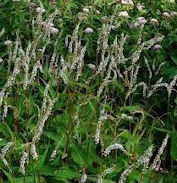 Persicaria White Eastfield
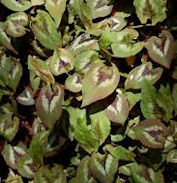 Persicaria Nepalensis
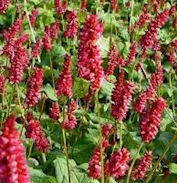 Persicaria amplexicaulis 'Lisan'
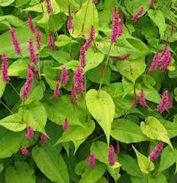 Persicaria Golden Arrow
|
 Persicaria Painter's Palette
 Lobelia laxiflora var. angustifolia
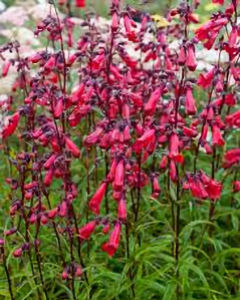 Penstemon Red Firebird
|
And just because one variety of a plant thrives don't assume that another of the same family will do likewise. Take pittosporum for example, which incidentally was amongst the GN drought beaters. I'd been trying to use water wisely: flowering perennials at the forefront of the borders once a day while shrubs at the back were being serviced by the irrigation system. Or so I thought! P. Irene Patterson? Bullet proof. But the burgundy leaves of
P. Tom Thumb had started to shrivel and shed, unnoticed by me due to their dark colour, and I only just managed to bring it back from the brink by copious drenching.
|
 Pittosporum Irene Patterson
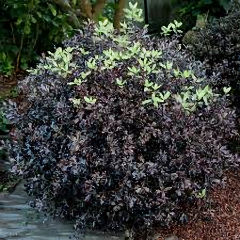 Pittosporum Tom Thumb
 Mahonia Soft Caress
|
An absolute surefire winner of Drought Tolerant Plant of the Year has to be
Mahonia Soft Caress. There it sits, under the canopy of our apple tree, day in and day out, evergreen, finely cut fern like leaves, arching habit to about 4ft tall, benefitting from the occasional splash of water. Next in line for the title, and almost obscured during the summer months by deciduous
Sorbaria Sem, is evergreen
Sarcococca confusa. Grown primarily for its intensely fragrant winter flowers, I think it deserves recognition for its graceful presence where other shrubs fear to tread, namely very dry shade.
|
 Sarcococca confusa
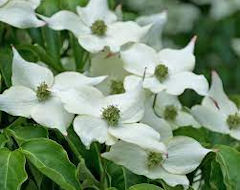 Cornus Kousa
 Viburnum plicatum Mariesii
|
My Cornus Kousa and
Viburnum plicatum Mariesii, on the other hand, with their elegant white flowers, bloomed oh so gracefully in the spring, only to have their delicate foliage scorched in the searing heat despite regular watering.
As part of my research for this article I viewed a Gardeners' World on-line special on Drought Resistant Plants
www.gardenersworld.com/plants/drought-tolerant-plants-to-grow/ I realised that this list (below), in fact any list, can only be a guide, as every garden is different. So, here's what I have experienced with their fourteen favourites:
- Agapanthus - flowered prolifically but over and done with much faster than usual.
- Anchusa - no problem, it has hairy leaves, more of that later.
- Cotyledon - I suspect that they were scraping the barrel by including obscure Cotyledon orbiculata. Not heard of it? Me neither.
- Geums - foliage crisped up from direct sunlight, arching flower stems wilted in the heat.
- Hardy geraniums - yes, oh yes, more next year for sure.
- Bearded iris - sorry, but I find their flowers, like gladioli, too stiff but no doubt they are drought proof because of their sword like leaves, another secret to success.
- Stipa tenuissima - Mexican Feather Grass, very tactile, requires dry well drained soil in full sun, but my goodness, if it likes you, it will seed itself everywhere.
- Nepeta - downy grey foliage, flowers for a long period. Sadly, the foliage just looked tired from too much sun. There are better options below.
- Pittosporum - small leaves fair better than some broad-leaved shrubs, but choose your variety carefully.
- Trachylospermum jasminoides - fantastic evergreen climber, wouldn't be without it. Dark green glossy, almost waxy foliage, neat habit. White flowers bearing intense fragrance, amplified by the heat.
- Sea holly - spiny blue flowers perfectly happy in the heatwave.
- Verbascum - downy grey foliage adapted to hot conditions.
- Artemisia - finely cut, silver foliage, ideal conditions.
- Sedum - fleshy leaves are water retentive and so can withstand extreme heat.
RHS Hyde Hall has been in the news lately, showing off its drought resistant borders: A Mediterranean style gravel garden, which, apart from watering in when first planted, hasn't been watered in 20 years. But best of all, in my eyes, are their vast curved prairie borders, full of miscanthus grass,
Verbena bonariensis, echinacea, rudbeckia and more. I reckon the secret of their success is very well drained soil. Now is the time to visit, when the gardens are at their peak!
|
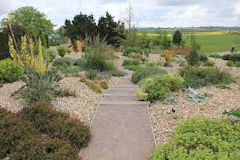 Hyde Hall Gravel Garden
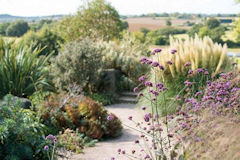 Hyde Hall Prairie Planting
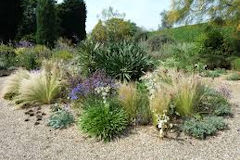 Beth Chatto Gravel Garden
|
And a stone's throw away is Beth Chatto's garden. Of course, she coined the phrase, Right Plant Right Place, which has never been so pertinent as it is now. In 1991, Beth turned the carpark into the famous Gravel Garden, never watered in decades and flourishing in one of the driest parts of the country. With no irrigation, and having poor, free-draining soil, it has become renowned for its spectacular display of drought tolerant plants.
And so, drawing from my own experience, this is my list of proven winners:
|
Hairy Grey Leaves
| Fleshy Leaves
- Euphorbia (toxic sap, handle with care, Don't plant if you have children or pets)
- Melianthus major
| Small Grey Leaves
- Shrubby salvias (same family as culinary sage)
- Penstemons (particularly ones with bushy habit such as Firebird)
|
Finely Cut Silver Foliage
- Erysimum Bowles Mauve
- Santolina
- Perovskia
- Caryopteris
| Sword-like Leaves
| Spiny or Prickly
|
Mediterranean Herbs
- rosemary
- lavender (caution, fails to thrive in heavy clay soil)
- oregano
- thyme
- chives
- marjoram
- sage
|
|
Amongst random plants that have thrived, in some cases a little too well, were climbing roses Summer Wine & Etoille de Hollande and my favourite shrub rose Mutabilis. Sanguisorba Lilac Squirrel, Sambucus Black Tower and Thalictrum flavum positively basked in the heat! Containers, the bigger the better, full of cannas, begonias and abutilon are thriving on the patio.
|
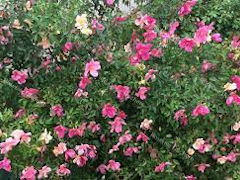 Rosa Mutabilis
 Sanguisorba Lilac Squirrel
 Bumblebee and Thalictrum flavum
|
I've had some spectacular casualties amongst so called drought resistant plants that should have known better: Grey hairy leaved pulmonarias went against the trend by disappearing below ground. Sword like leaves of crocosmia turned parchment. Ferns shrivelled up and had to be cut back to ground level.
Are we all going over to prairie planting from now on, swathes of ornamental grasses taking precedence over cottage garden favourites, I wonder? Or will rockeries have a comeback? Will we turn our plots into jungles, fill of exotic banana palms, tree ferns and tetrapanax?
One thing is for sure, we are going to have a lot of gaps to fill at the end of this season. What tantalizing opportunities lie ahead. Lead me to the garden centre!
|
| |
| Some links in this article may be affiliate links. If you click on them we may earn a small commission. |
| |
|
|


 P.O.Box 176, Wood Green, London UK N22 4BT
 +44 (0)20 8211 3325
 webmaster@teg.co.uk
Site Map
Legal Info
webmaster@teg.co.uk
Site Map
Legal Info