Myddelton House Gardens is the hidden gem in the crown of North London gardens. The life-long home of E A Bowles was a recipient of the Heritage Lottery Fund in 2011 and restored to tell the story of the famous botanist's life and gardening style.
The Life of E A Bowles
 E A Bowles
Edward Augustus Bowles was born in 1865 at the family's home in Enfield. As a child Bowles was a very keen natural historian and gardener and later, whilst studying at Cambridge for the priesthood, he joined the Cambridge Entomological Society.
It was in 1887 whilst completing his BA that tragedy struck the Bowles family, his brother and sister dying of consumption. Bowles returned to his parents to comfort them and abandoned professional priesthood. Instead, he devoted himself to helping his local church, the organisation and running of a night school for local boys, charitable work for the local poor and the creation of a garden from uninspired parkland at Myddelton House, which he inherited on his father's death in 1918. The children he helped and befriended either through the Church Lads Brigade, Forty Hill School or Night School became known as "Bowles Boys" and had the run of the garden at weekends where activities were laid on for them like fishing, football, cricket or skating on the pond or New River. Others could be found helping him in the garden, removing blanket weed from the pond, weeding and other tasks.
Bowles was a self-taught gardener, botanist, botanical artist, and garden writer as well as plant hunter. As a keen traveller, especially to Europe and North Africa, he brought home with him many specimens of plant. Such was his collecting zeal that, by the turn of the 20th century, he was growing over 130 species of colchicum and crocus. He also took a great interest in hardy cacti and succulents, admiring their "strange beauty" and protective spines.
In 1908 Bowles was elected to the Council of the Royal Horticultural Society. He was to serve on 15 committees and was a council member for 36 years, as well as attaining Vice-Presidentship from 1926 until a few months before his death in 1954. In 1916 Bowles received the society's highest award, the Victoria Medal of Honour. Following his death, an area of the RHS Wisley Garden was named Bowles' Corner. His ashes were scattered on the rock garden at Myddelton House.
"Gussie" to his friends, and "Bowley" to his RHS colleagues, E A Bowles' lasting legacy is broad, including his writings, and several hundred botanical illustrations, which are now held at the Lindley Library and Natural History Museum. The many plants named after him, (listed in the RHS Plant Finder), are a testament to his considerable knowledge and his remarkable garden at Myddelton House.
The Gardens at Myddelton House
Many of the features that Bowles created remain, such as the rock garden and an Alpine meadow, inspired by Bowles' plant hunting holidays in the Pyrenees mountains. The intriguingly curved lawn which runs down the middle of the garden, bookended by two bridges over grass, neither of them leading anywhere useful, was a branch of the New River running through Myddelton House to fill up the pond. Another feature is his so-called "lunatic asylum" of horticultural oddities, including the corkscrew hazel (Corylus avellana 'Contorta'), an unusually warped pine tree, extra spiky 'hedgehog holly', and an upright ivy bush. Once word spread, other gardeners sent Bowles cuttings of their own 'demented' plants for his collection.
The old Enfield market cross was salvaged to become the centrepiece of the rose garden. Parts of the medieval London Bridge have been in the gardens for some time. Around the garden are a number of round stone balls that are in fact medieval shots, used in catapult-style weapons. They were acquired by Bowles when they were discovered by a friend of his, after being uncovered by coastal erosion in Sandgate in Kent.
|
Among Bowles' methods of pest control was to go out at night with a torch and a hatpin to eradicate slugs. On one of the walls overlooking the kitchen garden, Bowles' initials that he carved in 1887 can still be seen.
Each season brings with it magic and wonder. Great drifts of crocus and narcissi adorn the spring borders.
 The Greenhouse
 Cactii and Succulents
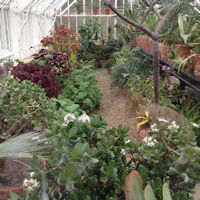
Rich beds of iris feature in early summer, dahlias in late summer. At high season the kitchen garden offers bountiful yields and colourful cut flower beds, the greenhouse is overflowing with succulents, cactus and hothouse plants.
Inside the glasshouses where the succulent plants are grown, many of the terracotta pots have an identical engraving: E A Bowles. They don't date from the Bowles' days, but the modern gardening team has them specially made.
In autumn the deciduous trees are adorned with fiery seasonal hues of red, orange and gold, drifts of ornamental grasses dominate the fading borders.
But it's in winter that I return, year after year, to savour its cool tranquillity. As you wander around the winding paths, you can see your breath in the crisp, still air. Too few visitors take advantage of these beautiful winter gardens; better for me, to have the grounds to myself. The young gardeners are busy wheelbarrowing in mulch, or winter pruning, and are always happy to update you on their activities. In winter, deciduous shrubs proliferate above swathes of hellebore and pulmonaria: Contorted hazel, twisted red willow, arching white-stemmed Rubus cockburnianus. To my mind, evergreen shrubs don't hold a candle to these architectural delicacies at this time of year. Above all, time your visit for the end of January, when you can enjoy the snowdrops at their very best.
This stark time of year gives you the chance to admire all the complexity and precision that goes into training the most perfectly pruned conference pears, end to end, over a 10m pergola.
|
Most of us have gazed up at tree canopies, densely colonised by mistletoe, but how many have been eye to eye with it? Up close and personal, it's fascinating to see how the mistletoe attaches itself to the host tree.
And there's nothing quite as evocative as the unexpected fragrance of viburnum, witch-hazel and edgworthia, whose delicate flowers adorn its outstretched bare branches.
The wisteria, reputed to have been one of the largest in the UK, sadly succumbed to old age in recent years, however I am delighted to report that strong new whips are growing from its base, ready to follow in its footsteps.
|


 P.O.Box 176, Wood Green, London UK N22 4BT
 +44 (0)20 8211 3325
 webmaster@teg.co.uk
Site Map
Legal Info
webmaster@teg.co.uk
Site Map
Legal Info